
MENTIRAS, Roberto Equisoain-Silvana Franzetti
Posted: June 1, 2010 Filed under: BOOKS/1+1=11 Editorial, INFO/ARCHIVE, PHOTO Leave a comment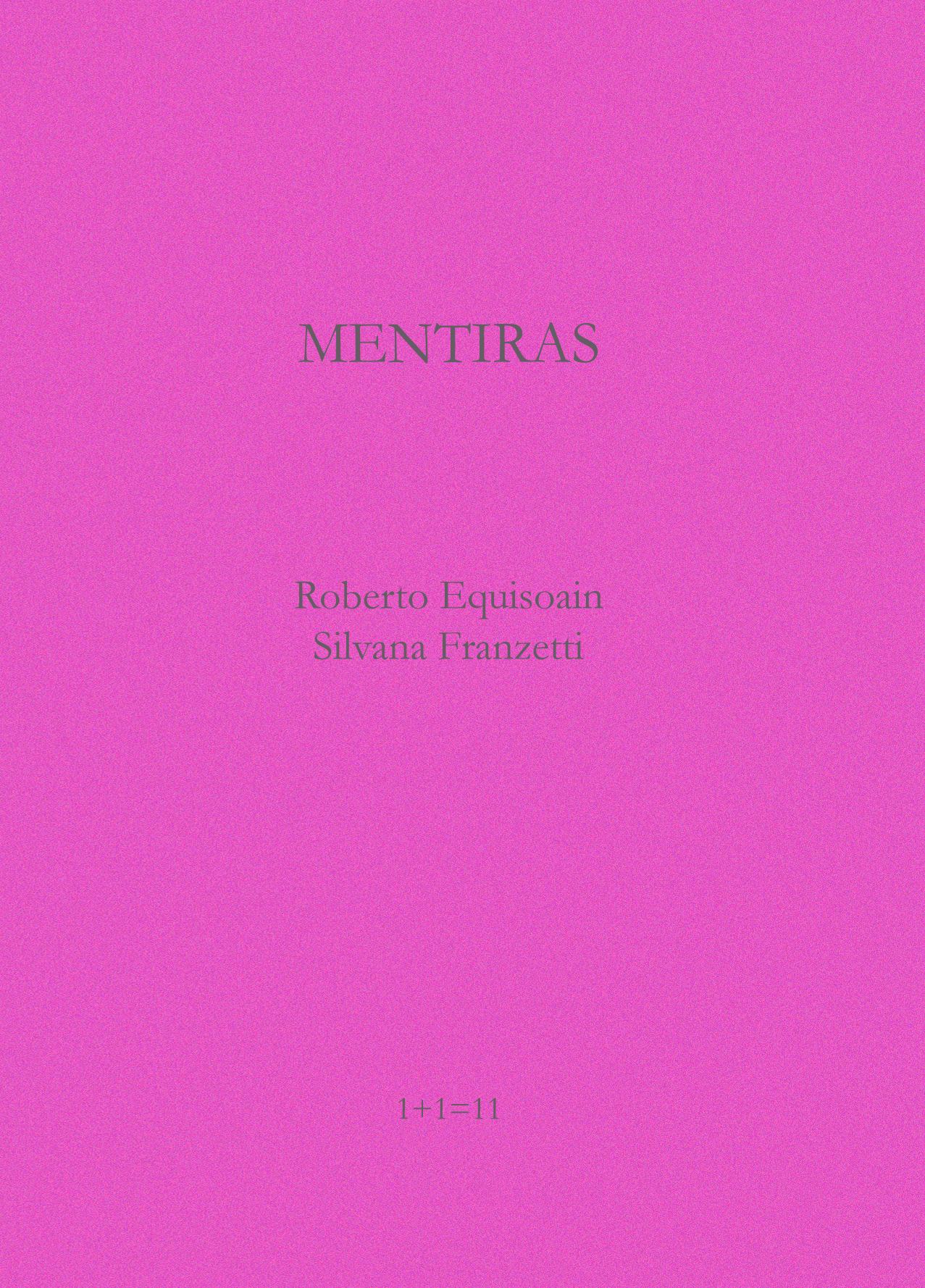 MENTIRAS
Primera edición: julio de 2010, 50 ejemplares
Poemas: Silvana Franzetti
Fotos y diseño: Roberto Equisoain
Edición: 1+1=11, 1+1=1
Con la colaboración: Siguaraya Galerie, Berlín
60 páginas
PVP: 10 €
Las mentiras son mecanismos, construcciones, como
las trampas para cazar animales. Esta idea hace
referencia a la reflexión del escultor Jorge Oteiza
de que el arte es una trampa, un cepo que intenta
atrapar el ser estético. Mentiras plantea la idea del
herror (escrito con h), del fallo que inevitablemente
se produce antes o después en el mecanismo de la
mentira. Muestra la necesidad humana de la creación
de engaños por medio del lenguaje y del arte para
atrapar una idea, algo irracional, inmaterial, quizá a
Dios.
BLABLABLABLA BLABLABLABLA BLA BLABLA BLA
Posted: May 9, 2010 Filed under: BOOKS/1+1=11 Editorial, INFO/ARCHIVE 1 Comment
Blablablabla Blablablabla bla Blabla Bla
Original Title: Universal Declaration of Human Rights
Editorial: produccionsescopeta
Translation and design: Roberto Equisoain
First edition: Mai 2010.
52 pages
ISBN: 978-84-936-3793-4
Blablablabla Blablablabla bla Blabla Bla is the translation of the 1948 Universal Declaration of Human Rights to Blablabla language.
The peculiarity of this book lies in that what is possible rests on the singularity of what has been erased. Once Blablabla spreads like a virus that does not resign itself to subvert or surpass the UN text: rather, it expands beyond its limits, infecting also title, author, editing and even the ISBN, making them disappear in the undifferentiated mass of blablablas.
In contrast with a language which, in its attempt to explain reality, is only able to reach a misinterpretation or, at best, a simplification, Blablabla takes precisely this simplification as its starting point, pushing it to the limits until reaching unintelligibility.
This does not imply, however, that Blablabla sacrifices meaning: as a playful game, Blablabla claims opacity and refuses to understand the World. In this book Blablabla is revealing in a way that countless discourses and elaborations have not been able to explain.
Blablablabla Blablablabla bla Blabla Bla
Título original: Universal Declaration of Human Rights
Editorial: produccionsescopeta
Traducción y diseño: Roberto Equisoain
Primera edición: Mayo 2010.
52 páginas
ISBN: 978-84-936-3793-4
Blablablabla Blablablabla bla Blabla Bla es la traducción de la Declaración Universal de los Derechos Humanos de 1948 al lenguaje blablablá.
La singularidad de este libro reside precisamente en que ha borrado todo rastro de singularidad, una vez que el blablablá se extiende como un virus que no se conforma con apoderarse de todo grueso del texto, sino que se expande más allá de sus márgenes, infectando también al título, el autor, la editorial o incluso el ISBN y haciéndolos desaparecer en la masa indistinguible de blablablás.
Frente a un lenguaje que en su intento de explicar la realidad lo que consigue es malentenderla o, en el mejor de los casos, simplificarla, el blablablá toma precisamente esa simplificación como punto de partida, llevándola al extremo hasta alcanzar lo ininteligible. Pero ello no significa que renuncie al sentido: como juego lúdico, el blablablá defiende la opacidad y se niega a entender el mundo, lo cual no significa que ocasiones, como en este libro, el blablablá resulte mucho más revelador acerca una cierta situación de los derechos humanos que una infinidad de discursos y palabras no han sido capaces de dar a entender.
.
PORNOMYSTIK/PORNOMYSTIC/PORNOMISTICA
Posted: May 8, 2010 Filed under: BOOKS/1+1=11 Editorial, INFO/ARCHIVE Leave a comment
“I will come with you inside of you…, love me because you are
very loved by me, more than you love me… for I have entered
into you, and you in me.”
Angela da Foligno, Il Libro dell’esperienza
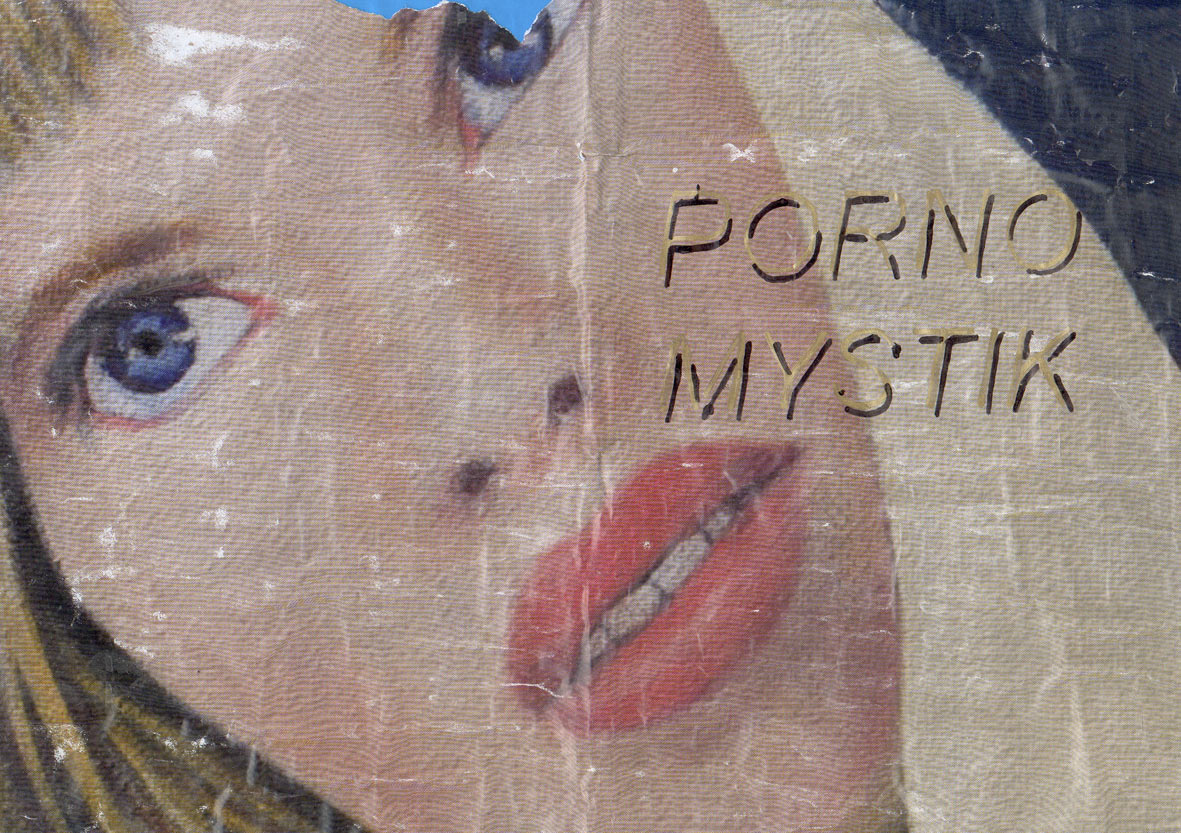

Porno and mysticism are two apparently contradictory languages but
are, in fact, very close to each other. Both reduce their expression to a
minimum, both search for the economy of words and images, both
simplify until they are emptied. In Christian tradition the obsession with
the body is fundamental and materializes in Christ’s body, God made
man. And especially interesting is the look of women, the women’s
view who in rapture intuitively and passionately write or dictate. In
this territory bordering between the spiritual and the carnal, they adore
Christ’s body, marry him, go to bed with him, fuck him. And they do it
without embarrassment, while directly looking into the camera.
Book + DVD
Editorial: PapperLaPapp
First edition: April 2010.
36 pages
“Vendré contigo dentro de ti…, ámame, porque tú eres muy amada
por mí, más de lo que tú me amas… puesto que yo he entrado en ti,
entra tú en mí.”
Angela da Foligno, Il Libro dell’esperienza
Porno y mística son dos lenguajes aparentemente contradictorios, pero
muy cercanos. Ambos reducen su expresión a lo mínimo, buscan la
economía de palabras e imágenes, simplifican hasta el vaciamiento.
En la tradición cristiana la obsesión por el cuerpo es fundamental, y
se materializa en el de Cristo, dios hecho hombre. Y es especialmente
interesante la mirada de ellas, mujeres, que escriben o dictan desde la
intuición y la pasión, en arrebato. En este territorio fronterizo, entre lo
espiritual y lo carnal, ellas adoran el cuerpo de Cristo y se desposan, se
acuestan, follan, con él. Y lo hacen pornograficamente, sin vergüenza,
mirando directamente a la cámara.
No haikus. Autumn, Winter, Spring, Summer
Posted: May 7, 2010 Filed under: BOOKS/1+1=11 Editorial, FILM/VIDEO, INFO/ARCHIVE Leave a comment Nohaikus. They are haikus and at the same time they are not. They are not haikus because they do not respond to the features of this genre of traditional poetry and they are because they are inspired by it and they intend to transfer it to the language of the images. A fragment of a river, a piece of sky, a part of a tree. Over a year I periodically recorded a video of the river, the sky and the tree: the passing of time, the seasons, the fall of leaves, the thaw or light changes are reflected in this way. Within this monotony the surprise is the great capacity of change of a landscape we believe static. I have chosen a particular place, which actually could have been any place; although the images seem to portray different spaces, they are always the same one. Maybe the important issue is simply to observe: stop and take the time to look at daily space, in which nothing happens, as though something extraordinary were taking place.
Título: No haikus. Autumn, Winter, Spring, Summer
Autor: Roberto Equisoain
Formato: 21 x 21 cm, tapa blanda, 88 páginas, con un dvd de 60 min.
Autoedición de 25 ejemplares, Berlín , 2009
Género: Arte, poesía, foto, vídeocreación
Los nohaikus son haikus y no lo son. No lo son porque no poseen los requisitos de este tipo de poesía tradicional y sí porque se inspiran en ella e intentan transferirla al lenguaje de las imágenes. Un fragmento de río, un trozo de cielo, una parte de árbol. Durante un año, de forma periódica y desde el mismo lugar he grabado en vídeo el río, el cielo y el árbol: así se refleja el paso del tiempo, las estaciones del año, la caida de las hojas, el deshielo o los cambios de luz. Dentro de esta monotonía la sorpresa es lo muy cambiante de un paisaje que creemos estático. Quizá lo importante es simplemente observar: detenerse y quedarse mirando como si en lo cotidiano, donde aparentemente no pasa nada, estuviese sucediendo algo extraordinario.
3 FALLEN TRAPS TRAMPAS (book, libro)
Posted: May 6, 2010 Filed under: BOOKS/1+1=11 Editorial, INFO/ARCHIVE Leave a comment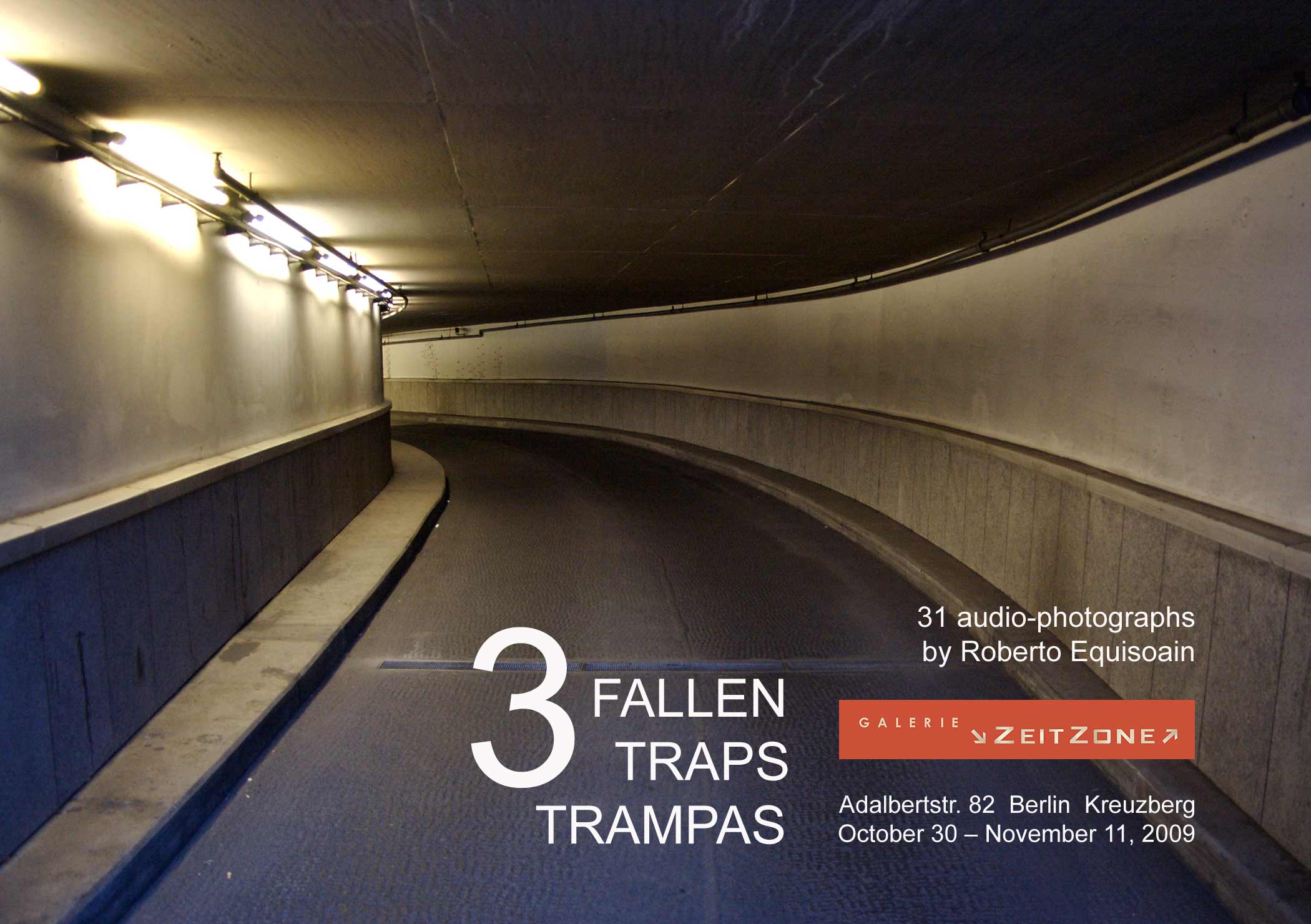
Roberto Equisoain. 3 traps: gas stations, ramps and empty places.
The shelter, the hatred, the stage. They are three series of images of architectures. They are dehumanized places reduced to shape, color and texture. By means of photography (change of dimension, simplification and isolation) the spectator has the general impression that the photographed architectures are sculptures, where the inner space of the architecture materializes in volume. It is like a trap, an attempt to grasp spaces, to bring them to the manageable size of the hand.
Gas stations
9 + 2 night photographs of buildings of gas stations. The idea starts from a quotation from the film Breakfast at Tiffany’s: “I don’t want to own anything until I know I’ve found the place where me and things belong together. I’m not quite sure where that is just yet. But I know what it’s like. It’s like Tiffany’s.” It represents the search of an imaginary paradise, the place that provides security – physical and mental security -, fictitious security, maybe fake security, but security after all, security more than enough for our own peace of mind.
Ramps
Series of photographs of interior ramps of car parks. It starts from a cinematographic quotation in Gilda: “I hate you so much, I think I’m going to die from it… darling.” Hatred as a contradiction, as the beginning of passion. Maybe these photographs are the innards of an animal, a clean and cold animal, without viscosity, made of darkness and depth whose name, to put it without any kind of dramatism, is hatred.
Empty spaces
Pairs of photographs of empty spaces or abandoned places which have lost their furnishings and their references as habitable spaces. This dehumanization transforms them in elemental forms for aesthetic contemplation; hence the obsession with abandoned buildings or buildings in construction. These images are like stages, empty stages with a fake stillness, like places where something is about to happen all of a sudden or where something happened long ago.
Roberto Equisoain (Pamplona, 1973) lives in Berlin since 1998. He works mainly with video and photography. Often the series of images he makes serve as material for the creation of experimental video art work and artist books. Urban architecture constitutes one of the central themes in his work: empty places which are reduced to their essential shape and combined with cinematographic and literary references.
……………………………………
Roberto Equisoain. 3 trampas: gasolineras, rampas y lugares vacíos.
El refugio, el odio, el escenario. Se trata de tres series sobre imágenes de arquitecturas. Son lugares deshumanizados y reducidos a forma, color y textura. A través de la fotografía (cambio de dimensiones, simplificación y aislamiento) la impresión general es que lo fotografiado son esculturas, que el espacio interior de la arquitectura se materializa en volumen. Como un atrapamiento, un intento de asir los espacios, de llevarlos al tamaño manejable de la mano.
Gasolineras
9 + 2 fotografías nocturnas de edificios de gasolineras. La idea parte de una cita de la película Desayuno con diamantes: “No quiero tener nada mío hasta que encuentre un sitio donde yo y las cosas vayamos juntas. No estoy segura dónde será pero sí el aspecto que tendrá. Debe ser como Tiffany’s.” Se trata de la búsqueda del paraíso imaginario, el lugar que da seguridad, seguridad física y mental, seguridad ficticia, quizá falsa seguridad, pero seguridad finalmente, seguridad más que suficiente para tranquilizarse.
Rampas
Serie de fotos de rampas de parkings, curvas en pendiente. Parte de una cita cinematográfica de Gilda: “Yo también te odio. De tal modo que… que creo que voy a morir… cariño. ” El odio como contradicción, como principio de pasión. Quizá estas fotos son las tripas de un animal, un animal limpio y frío, sin viscosidades, hecho de oscuridad y profundidad, que, cómo decirlo sin ningún tipo de dramatismo, se llama odio.
Lugares vacíos
Parejas de fotografías de lugares abandonados o vacíos que han perdido el mobiliario y las referencias de espacio habitable. Esta deshumanización los transforma en formas elementales para la contemplación estética; de ahí la obsesión por edificios abandonados o edificios en construcción. Estas imágenes son como escenarios, vacíos, pero con una tranquilidad falsa, como lugares donde va a ocurrir algo inmediatamente o donde ocurrió algo hace mucho tiempo.
Roberto Equisoain (Pamplona, 1973) vive en Berlín desde 1998. Trabaja sobre todo con vídeo y fotografía. En muchos casos las series de imágenes sirven como material para realizar a partir de ellas piezas de videoarte y libros de artista. La arquitectura urbana constituye uno de los temas centrales en su trabajo: lugares vacíos reducidos a sus formas esenciales que se combinan con referencias cinematográficas y literarias.
 robertoequisoain.com